Wednesday, March 16, 2011

Wagon Master (1950)


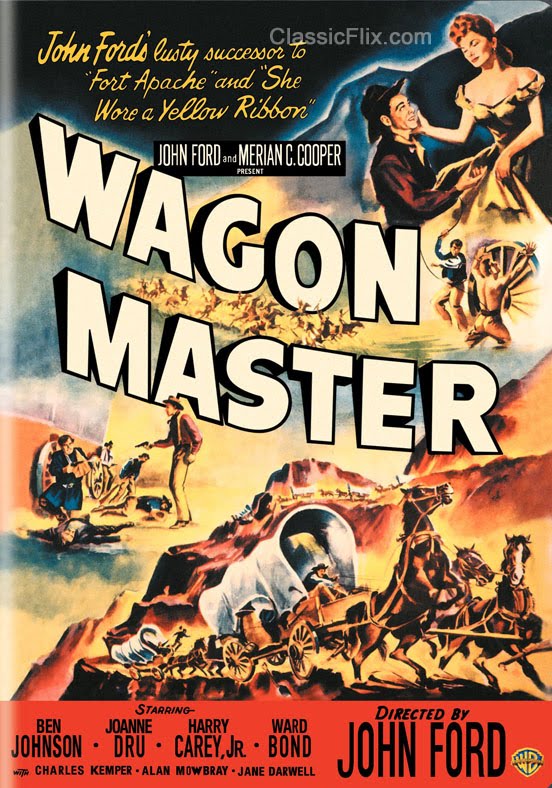
Done prior to learning how to capture images, this John Ford film is great. The Mormon history is amazing to learn, and Ford captures this along with bringing new elements [those not of the same faith]. I would watch this movie again. It was fun to watch, but not the greatest slice of western cinema. Pink mark. I think my standards are getting too high. Found in my "Videohound 2002".

Tuesday, March 15, 2011

WUSA (1970)

To say that WUSA is a hot movie would be an understatement. From our opening scenes of a Mardi Gras festival about to begin to the constant perspiration of our central characters, WUSA not only visually puts us deep into the South, but physically places us there as well. WUSA represents one of those internal films that is difficult for the American populace to swallow. It is a film about race. It is a film about prejudice. It is a film about individual self. As WUSA opens, it is quiet. The festival is about to begin, and like the audience, there is a looming sense of unknown. What is this movie about? Why is it quoted as his "favorite" by Paul Newman? With the last question lingering on your tongue, it begins. The parade yells, the people destroy, and Newman's Rheinherdt stumbles, literally, into town. Like a gunslinger just passing through, Newman is armed with merely a thermos full of liquor, a conservative mind, and a past that takes nearly two hours to undress.


So it begins. WUSA's central protagonist is discovered, but unlike the typical linear film, two other determined, emotionally challenged characters walk into the quintessential bar. One, a man with a slight studder who believes he is working for the Welfare system, the other, a homeless woman with a scar just trying to get a good meal for the evening. As both of these (as well as Newman) walk through the streets of Louisiana, it quickly becomes hotter. Newman, hugging his thermos like it is his personal protector, stumbles into Joanne Woodward, and together a spark in the heat is developed. Meanwhile, Anthony Perkins surveys the other side of the South. The questionable ethics of the Welfare system is discovered, and what already feels like your sitting on the sun, suddenly explodes. The visuals that director Stuart Rosenberg brings to the table are nearly that of von Trier's chaotic images of America. They are bold, beautiful, sad, triumphant, and debilitating to the mind all at the same time. He not only uses actors to take on the roles of those with needs, but also inserts fantastic in-time photos of life in the South. Images have that 1,000 word opportunity:


Racial moments, scratching for an opportunity to breathe, the heat of the South all swirl together to bring you the backbone of this film, but there is another element trying to peak from beneath the sheets. That is our title character. Our radio station WUSA who pushes the envelope of suspense and quickly transforms into our villainous cohort. Rosenburg isn't afraid to demonstrate how evil this radio station is with an iconic shot that had to be reported. Check out this pre-Guy Ritchie scene that just leaks cool and pushes the boundaries of this little independent unknown.


This is a film that speaks about its audience, not to it. As we listen to the pit-bull owner of the station talk about big things, about the change in their dynamic, and decidedly about Newman's role in the upcoming rally, the words speak about the media today. They open the window towards the future, and WUSA takes on a whole new shape as the speaker of not just racism in the media, but also the role media will play in accordance with news. As the heat continues to grow, our characters cannot help but become further intertwined. As the community speaks about the horrors of WUSA, Perkins pushes himself onto Newman, questioning his very words. Newman in turn continues to drink, and falls into the arms of Woodward, who feels more like a child of the 60s then a genuine character. Despite her inability to bring emotions or full lines to the surface, she looks good making this picture, and matches well with Newman's startling blue eyes (which is why they worked in real life as well).


With fans blowing cool ice, hippies living next door, the inevitable picture explodes before us. To continue to use words that are heat induced, it only compliments this film. There is a tense scene over drinks and drugs on a hot night as Newman argues semantics with Perkins, pushing the envelope of truth and discovering the two sides to this pot boiling story. Then, the event happens.

Originally outsourced as a huge, life-changing event slowly transforms into lifeless blubber and a disappointing finale that couldn't match that of the early intensity. Newman mutters his way until the final credits, giving a very slight indication of what life looked like. The surprise with Perkins and the continued misguidance of Woodward, merely add to this limber ending. WUSA had the balls to become a very timely and still relevant film, but this ending flounded any possiblities.


I wanted to like this film, and in the end I am thankful that I saw it. Up through the first 3/4ths of this movie, I was standing in front of a hot stove on summer waiting for the American Pie to be ready, but in the end, all I had was a burnt mess of what could have been a joyous eating experience. Paul Newman, despite the ending, was amazing. Pulling from a young Marlon Brando vs. the Newman career that existed prior to his death. Joanne Woodward was beautiful, and together their chemistry was not bounded by the film, while Anthony Perkins gave us a startling truth about religion, persona, and values. Rosenburg's direction was tight and scenes just oozed beauty. Watch where his camera finds its shots. Plenty of close-ups and under the table shots, continuing to give us that moment of honest coupled with cramp living quarters. Again, this was a hot film and Rosenburg never let us forget that. The side stories remained invaluable, while the ending is what lost me.


Overall, this was a great film, but could have been a bit tighter by the end. Found in my "Videohound 2002" book, this will sadly get a pink highlight. Liked it, but didn't love it merely due to the ending. This was, and still is a powerful film, but unlike "Mississippi Burning", it just doesn't have that BAM! ending to it that leaves your jaws on the floor and honesty in your mind. I could easily suggest this film, but not watch again. What this film made me realize is that I need to see more young Paul Newman, more Joanne Woodward, and more more more Anthony Perkins, the man who did live outside of Psycho.

Monday, March 7, 2011

Quality Street (1937)

Quality Street: The Use and Misuse of the Comedic Switch

Reaching deeply into the Warner Brothers Archive, my arm easily grabbed a little film from the late 30s which boasted a start that was considered "box-office poison" as well as a comedic story that felt dated and painfully convoluted. Katherine Hepburn, easily one of the most iconic leading ladies in cinema, was at one time considered the worst choice to headline a feature film. Quality Street was smack in the hayday of Hepburn's downward trend [despite her soon upward mobility]. Despite the beauty that she brings to the screen, despite the emotion that she can muster even for a comedic role, Hepburn is a flaw with this film. Was her title of "box-office poison" not as premature as we may think? Is it her, or merely the lacking material she had to work with? As we look further into Quality Street, we will need to dissect both the comedy of the scenes as well as the elements that Hepburn brought to distinguishing Miss Livvy from Miss Phoebe. For those unaware of the tremulous story behind Quality Street it surrounds a love between an aging woman and a man who has chosen the Army instead of marriage. It is about a love that is 10-years old and the choice of beauty over person. Dr. Brown returns within that time span and to Phoebe's misunderstanding, believes he would prefer the younger version of her own self [she has just turned 30 and weakly describes the downward spiral from 29 to 30]. So, instead of confronting Dr. Brown with her feelings, she spends over an hour devising a plan where her alter-ego, Miss Livvy, is her exciting, younger version of herself. She goes out, she has fun, she shows Dr. Brown, as well as others from the Army, what a young woman is like. Like all films of this nature, the crux comes with the inability to be in two places at once, and slowly Phoebe's plan becomes too difficult to handle.Slowly, the film begins to unravel. Not only do our creators make our actors run to continue the rouse, but they weight down the final act, giving us less realism and more absurdity to wrap up this tall tale. Our characters are forgotten merely to put an end to the farce. Does this work? No. By the end, it is unclear as to why love exists at all. It is unclear as to why Dr. Brown went through the entire ordeal at all. It is unclear as to why he brings this sign from outside [the only job these two women have to support themselves] and tells Susan (the older sister) to use it as firewood. It is the fogginess of these elements that create confusion instead of excitement as our two love-birds finally embrace.Adding to this mix is a group of sinister spinster who show no passion for anyone except for gossip. They seem hell-bent on finding out the truth, no matter what friendship is hurt in the process.These batty old women [who are genuinely old], are placed as the comic relief of this film. They are added to create further tension and as an outside "evil" element against our heroine Phoebe. What should have come across as funny, just transforms into annoying as these three find themselves everywhere they plausibly could not be. Dances, sneaking inside the house, random placement, these women are interjected, not story driven, thus nagging on Hepburn's back instead of adding to her comedic peril. Add to this mix another larger, plump man [one of only four within this entire film] who uses the wink to spook these women who believe love is the work of the devil, yet cannot seem to fathom why they do not have men themselves. It is a less engaging process, only dumbfounded by the fact that nobody is funny. Agreed that it is tense, but funny it is not.
Obviously, from these photos. Miss Livvy is the only available woman for the Army to enjoy. Geesh.
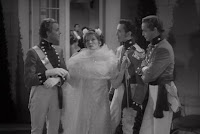
This leads to three final elements on why/how Quality Street remains good, but fails to be great. The first being that Phoebe actually courts other men. There are a group of soldiers who are all vying for the prize of Miss Livvy's heart, and the wake of Phoebe's uninstructed idea there are more that find themselves hurt than Phoebe's attempts for love. The above laughing man is caught in a moment, little does he know, the walls are about to crumble down upon him. The next has to be with the logistics of this story. It was originally a play developed and written by J.M "Mr. Peter Pan" Barrie himself, but transformed into a film there are just too many cinematic plot holes that can be forgotten in the stage setting. The third and final discuss the idea of what Hepburn must do to solidify her character. She needs to be two different people. She does not do this.Notice the shot in this photo above. This is the big surprise at the end, the idea to end all ideas that provides less laughs but instead an end to a long-winded tunnel of cinema. For those at home unaware of how Hepburn transforms from Miss Livvy into the aging Miss Phoebe, it involves less makeup, but instead a mere night cap. When Hepburn's hair is covered, she looks wicked old, but when she is the young & the restless, she puts her hair up and regains that spring in her step. The average person would not see the difference, but thankfully, the Doctor - the man who uses his eyes for surgery - cannot see any problems. Arg, if only he was watching this movie.

Despite the push for patriotism early within Quality Street, I can see why this film never made it as a full blown DVD release. Actually, what Quality Street did for me was realize that the Warner Archive has much much to offer. This is my second film I have watched from that collection, and while this wasn't as impressive, seeing Hepburn in a less flattering role helps solidify her as a less bankable star. She had troubles, just like those actors today who find themselves doing the forth sequel for the money. Quality Street is no Blithe Spirit, and I feel like the two shouldn't fit together - but there are "play" elements that fit. I thought about Blithe while watching this because of the simplicity, and how it ruined this film but empowered Blithe. Ok, I realize that was a random tangent for the end, but it just flew together.

Overall, I was mediocrely impressed with this film. It had potential, but ultimately focused on the wrong parts to make it a detailed comedy. The use of the switch was horrible, thus causing the remaining framework to crumble behind. A long time coming, but this was found in my "Videohound 2009" book. This ends the Qs, which was a middle of the road battle for me. This is getting a pink mark. Good, but not great. I could suggest this to friends who enjoyed the age of the film, but sadly, it just didn't fully work for me.

How about those pictures?
Thursday, February 24, 2011

Waco (1966)


Discovered in my "Videohound 2002" book, this was a movie I began liking, but lost steam as the film finished. Decent, but not as impressive as it began. I liked it, but didn't love it. The jabs will make you smile. Pink Mark.

The Naked Kiss (1964)


Look at this awesome box art. Can't get any better. Well, it can - for those who haven't seen this film. You gotta see it. Found in my "Videohound Cult Flicks & Trash Picks". This was a shocker in 1964 and still today. Wowsers. Green highlight with blue stars. Solid.

Naked (1993)


Found in my "Videohound Cult Flicks & Trash Picks", this Criterion film gets a green highlight with blue stars. Perfect.

Monday, January 31, 2011

Naked Lunch (1991)


Found in my "Videohound's Cult Flicks & Trash Picks". The thinking man's drug movie. Why isn't this requested more than "Requiem for a Dream", "Fear and Loathing in Las Vegas" or even "Kids", or "Blow". That will never make sense to me. A very big green mark with blue stars. I will watch this, trying to solve the puzzle of this drug ridden universe. Thank you David Cronenberg for messing with my mind.